The Making of the Aborigines by Bain Attwood
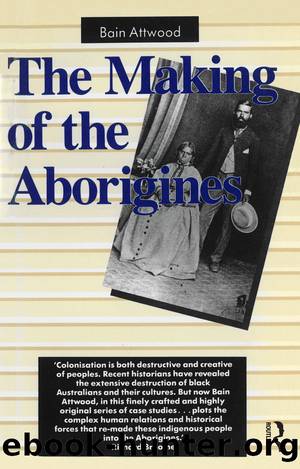
Author:Bain Attwood [Attwood, Bain]
Language: eng
Format: epub
ISBN: 9780043701850
Barnesnoble:
Publisher: Taylor & Francis
Published: 1989-08-01T00:00:00+00:00
the reserve and better paternalistic management; on the first issue they did not argue in terms of the land being theirs from time immemorial but claimed instead that it was granted to them as compensation by a former governor, and that they would further legitimise their right to the property by using it productively and making themselves self-supporting; on the second matter, they demanded âsome man over usâ, preferably the founding manager, John Green, who had ruled them sympathetically. They emphatically rejected the Boardâs intention of removing them from Coranderrk and condemned its appointee managers. A number of factors made for their unprecedented protest. They had been disadvantaged by the policies of faceless bureaucrats and the practices of harsh managers, more so than any other mission, and had come to see clearly that they had interests which conflicted with the Boardâs. Their sense of common cause sprang from their shared experience of oppression on the reserve and this was reinforced by their traditional clan affiliations. As they battled the Board over several years, though, they increasingly developed a different consciousness of themselves, as âCoranderrk Aboriginesâ rather than âthe Kulinâ.51
Their well-organised agitation had a legitimacy which won much political support and which the Board found difficult to counter. During these years it was consequently in an embattled position, lurching from crisis to crisis and at times fighting for its very survival.52 This made radical policy changes difficult to achieve, even if the Board and the missionaries had been committed to a thoroughgoing program of reform, which they were not. In the early 1880s they continued to look for measures to strengthen âthe missionary systemâ while also considering some minor reforms along inclusionist lines. Hagenauer sought a way for tackling what he called âthe somewhat difficult questionâ of âthe people of mixed bloodâ but was yet to accord it special significance.53 These piecemeal moves towards radical reform were, in any case, characterised by uncertainty about whom they should refer to. In particular there was disagreement over whether young single women could go off the missions into apprenticeships, as philanthropist and pastoralist Ann Bon recommended. The Board and the missionaries opposed this. The missionariesâ segregationist policy had owed much to their middle-class Christian view of working-class male sexuality: they believed that Aboriginal women would be exploited by rapacious European men unless kept within the sanctuary of the reserves and under missionary protection.54 (The Board and the missionariesâ rejection of any scheme to send girls or young women away also owed something to their hostile attitude to its promoter, a very independent-minded widow who was one of the Boardâs most fierce and effective critics.)55
On this issue a stalemate developed, one which remained until Hagenauer stepped forward in 1884, determined now on a new policy and ready to play the politics of expertise. This Moravian missionary was an ambitious man, more than he himself realised or would allow; he loved to be at the political centre and was a brilliant strategist and operator. By the
Download
This site does not store any files on its server. We only index and link to content provided by other sites. Please contact the content providers to delete copyright contents if any and email us, we'll remove relevant links or contents immediately.
| Anthropology | Archaeology |
| Philosophy | Politics & Government |
| Social Sciences | Sociology |
| Women's Studies |
Cecilia; Or, Memoirs of an Heiress — Volume 1 by Fanny Burney(32573)
The Great Music City by Andrea Baker(32038)
Cecilia; Or, Memoirs of an Heiress — Volume 2 by Fanny Burney(31969)
Cecilia; Or, Memoirs of an Heiress — Volume 3 by Fanny Burney(31949)
We're Going to Need More Wine by Gabrielle Union(19062)
All the Missing Girls by Megan Miranda(16081)
Pimp by Iceberg Slim(14543)
For the Love of Europe by Rick Steves(14236)
Bombshells: Glamour Girls of a Lifetime by Sullivan Steve(14091)
Talking to Strangers by Malcolm Gladwell(13394)
Norse Mythology by Gaiman Neil(13387)
Fifty Shades Freed by E L James(13252)
Mindhunter: Inside the FBI's Elite Serial Crime Unit by John E. Douglas & Mark Olshaker(9359)
Crazy Rich Asians by Kevin Kwan(9304)
The Lost Art of Listening by Michael P. Nichols(7516)
Enlightenment Now: The Case for Reason, Science, Humanism, and Progress by Steven Pinker(7321)
The Four Agreements by Don Miguel Ruiz(6772)
Bad Blood by John Carreyrou(6629)
Weapons of Math Destruction by Cathy O'Neil(6292)
